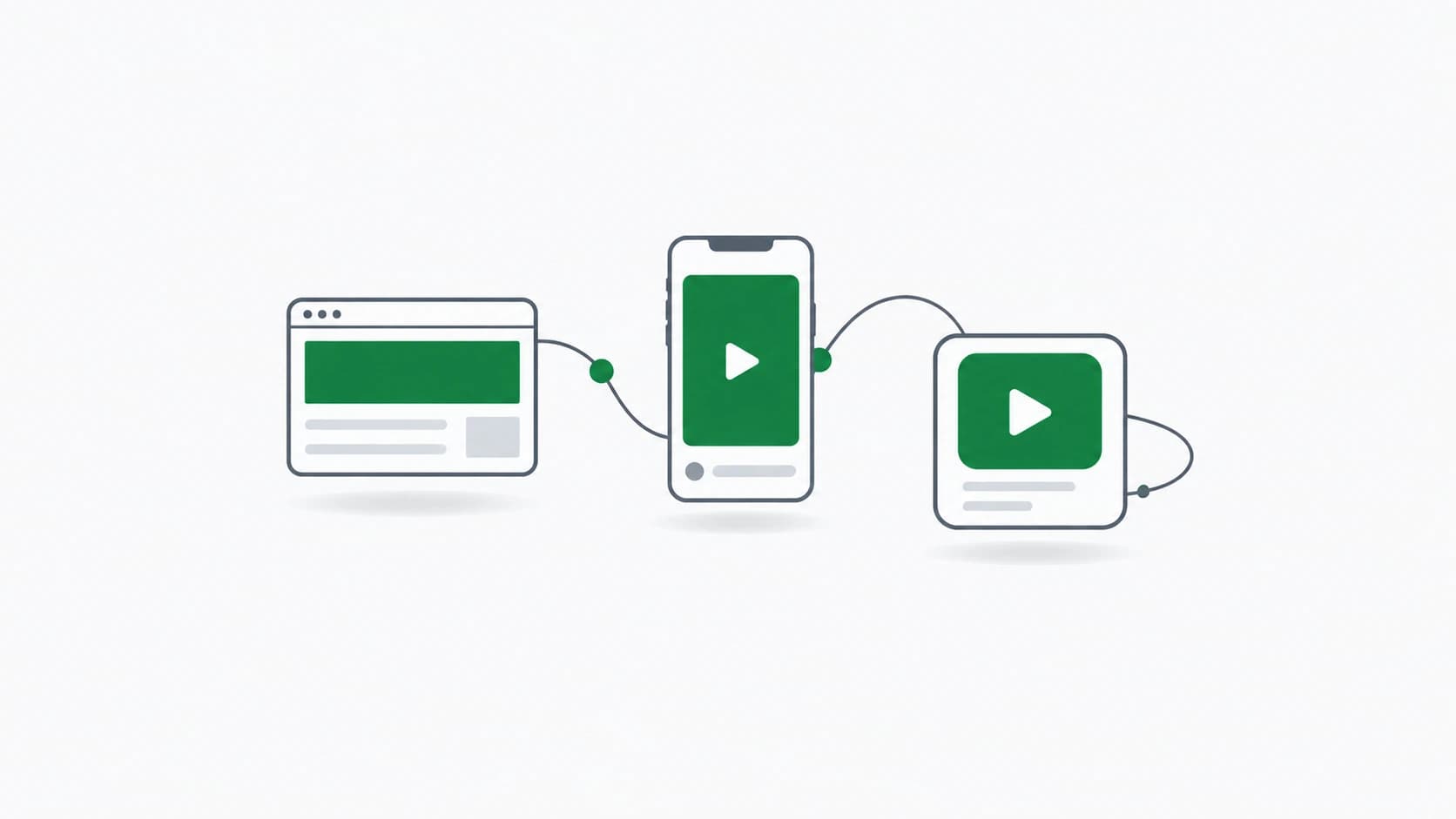
Google Ads runs campaigns across several distinct networks under one account, and CPM behaves a little differently in each. The underlying math never changes — cost divided by impressions, times 1,000 — but what counts as an impression, how much control you have over the rate, and how the number gets reported all shift depending on whether you're running Display, YouTube, or Performance Max.
The Formula Doesn't Change
No matter which Google Ads campaign type you're looking at, CPM is calculated the same way. Pull the cost and impressions from any campaign report and run them through the CPM calculator to check your numbers:
CPM = (Cost ÷ Impressions) × 1,000
Display Network
The Display Network is the most straightforward of the three for CPM purposes. It supports Target CPM bidding directly, meaning you can set the rate you're willing to pay per thousand impressions and let Google's auction system deliver against that target.
Because Display inventory spans millions of sites and apps of wildly varying quality, viewability is a bigger factor here than on more curated networks — a low headline CPM on a page footer placement can still be a poor deal if few of those impressions are ever seen. It's worth reading alongside CPM vs vCPM when evaluating Display placements specifically.
YouTube
YouTube campaigns are usually built around video-specific goals — views, watch time, or conversions — rather than a direct CPM bid. Skippable in-stream ads are commonly billed on a CPV (cost per view) basis, only charging when a viewer watches a meaningful portion of the ad or interacts with it; non-skippable formats like bumper ads are typically CPM-based, since there's no partial-view outcome to bill against.
Even when a campaign is billed on CPV, Google Ads still reports an effective CPM in the performance columns, which makes it possible to compare a YouTube campaign's cost-per-reach against a Display or social campaign priced purely in CPM terms.
Performance Max
Performance Max campaigns run across Search, Display, YouTube, Gmail, Discover, and Maps simultaneously, with Google's automation deciding in real time where each impression comes from based on the campaign's conversion goal. The CPM you see reported is a blend across all of those surfaces, not a single-network rate.
That makes Performance Max CPM harder to benchmark directly against a standalone Display or YouTube campaign — a rise in blended CPM might simply mean the algorithm shifted more delivery toward a higher-value surface like YouTube, not that any individual placement got more expensive. Asset group and channel-level reporting (where available) gives a clearer picture than the headline account-level number.
Reading a Real Report
Say a Display campaign report shows $840 in cost and 210,000 impressions for the month. Running that through the standard formula:
CPM = ($840 ÷ 210,000) × 1,000 = $4.00
If a Performance Max campaign running alongside it shows $1,600 in cost and 200,000 impressions, its blended CPM works out to $8.00 — double the Display rate. That doesn't necessarily mean Performance Max is a worse deal; it likely means more of that budget was allocated toward YouTube or other higher-value surfaces where the automation judged it would drive more conversions, even at a higher cost per thousand impressions.
Which One Should You Use?
The right campaign type depends on how much control you want over where your budget goes versus how much you trust the automation to find efficiency on its own.
- Choose Display when you want direct control over CPM bids, specific placement targeting, or a predictable reach-based campaign with minimal automation.
- Choose YouTube when video is central to the creative strategy and you want format-level control over skippable versus non-skippable placements.
- Choose Performance Max when the priority is a conversion goal and you're comfortable trading placement-level visibility for automated, cross-network optimization.
Many advertisers run more than one of these simultaneously — a Display campaign for controlled reach alongside a Performance Max campaign for conversion volume — rather than treating the choice as exclusive. For a broader look at why CPM, CPC, and CPA pricing suit different goals, see CPM vs CPC vs CPA.
Managing CPM Across Campaign Types
- Use frequency capping on Display — capping how often the same user sees an ad prevents budget from concentrating on a small, oversaturated audience.
- Exclude poor-performing placements — the Placements report under Display surfaces specific sites and apps; excluding the weakest ones improves the average CPM over time.
- Segment YouTube by format — comparing skippable in-stream against bumper or non-skippable formats separately gives a much clearer read than looking at a blended campaign average.
- Review Performance Max insights regularly — the asset group and search category reports are the closest thing to placement-level visibility that Performance Max offers.
- Compare like with like — a Display CPM and a Performance Max blended CPM are measuring different things; don't treat a difference between them as a straightforward efficiency signal.
- Check the change history — before reacting to a CPM shift, check whether budgets, bid strategies, or targeting settings changed around the same time, since those are often the actual cause.
Frequently Asked Questions
Where do I find CPM in Google Ads?
In the campaign or ad group view, add the "Avg. CPM" column, or divide the values in the Cost and Impr. columns yourself and multiply by 1,000. You can also plug those two numbers into the CPM calculator directly.
Can I set a target CPM in Google Ads?
Display campaigns support Target CPM bidding directly. YouTube and Performance Max are typically optimized toward other goals (views, conversions, or value), with CPM reported as a resulting metric rather than a bid target — though you can still monitor and react to it.
Why is my Performance Max CPM higher than my old Display campaign?
Performance Max blends inventory across Search, Display, YouTube, Gmail, and more, and some of that inventory (like YouTube video placements) naturally carries a different rate than static Display banners. A blended CPM isn't directly comparable to a single-network CPM.
The CPM formula stays constant across every Google Ads campaign type, but what it's measuring shifts depending on the network and the automation layered on top of it. Reading CPM correctly means knowing whether you're looking at a directly-controlled rate, a video-specific blend, or a fully automated cross-network average — and comparing each against the right baseline, not each other. Treat a rising CPM as a prompt to check where the delivery shifted before assuming the campaign got less efficient.
Check your own Google Ads numbers against the standard formula: Use the CPM calculator
Related Reading
Builds and maintains CPM Calculator, a free tool used to plan ad spend and check impression pricing across campaigns. Writes about the pricing models and formulas behind digital advertising.