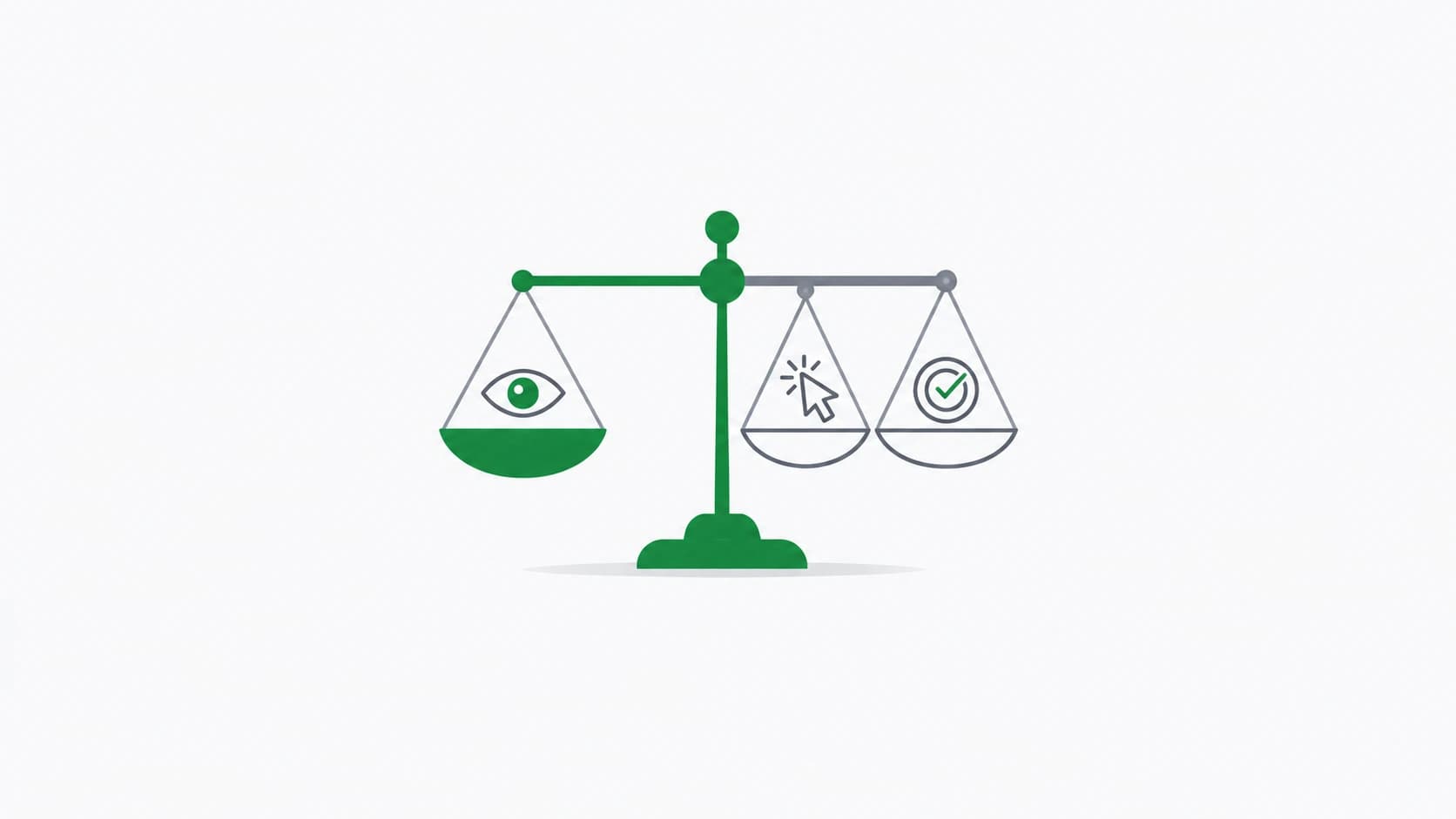
Every ad campaign has to answer a deceptively simple question before a single dollar is spent: what are you actually paying for? Impressions, clicks, and conversions each put the risk of an underperforming campaign on a different party — and picking the wrong model for the situation can quietly undermine an otherwise solid campaign, no matter how strong the creative or targeting behind it happens to be.
CPM: Paying for Reach
CPM (cost per mille) charges a fixed rate per thousand impressions, regardless of what happens after the ad is seen. You can work out CPM, cost, or impressions for any campaign with the CPM calculator.
CPM = (Total Cost ÷ Total Impressions) × 1,000
The advertiser carries the risk here: you pay the same rate whether the audience clicks, ignores, or converts. In exchange, CPM is usually the most predictable model to budget against — you know roughly how much reach a given spend will buy before the campaign even launches.
CPC: Paying for Traffic
CPC (cost per click) shifts the risk partway toward the publisher: the advertiser only pays when someone actually clicks the ad, not simply when it's displayed.
CPC = Total Cost ÷ Total Clicks
This is a meaningful improvement for advertisers over pure CPM, since you're no longer paying for impressions nobody engaged with. But it's still not tied to outcomes — a click that bounces immediately costs the same as one that converts. CPC and CPM are directly convertible using the campaign's click-through rate, which is useful when comparing inventory priced differently:
CPM = CPC × CTR × 1,000
CPA: Paying for Outcomes
CPA (cost per action) moves the most risk onto the publisher: the advertiser only pays when a defined action happens — a signup, a purchase, an app install.
CPA = Total Cost ÷ Total Conversions
From the advertiser's side, this is the closest thing to a guaranteed return — you're paying directly for the result you wanted. But someone has to absorb the uncertainty of whether that traffic converts, and in a CPA deal, that's the publisher. Because of that, CPA inventory is often priced at a premium per unit, and not every publisher is willing to accept CPA terms at all — it depends on how confident they are in their own traffic quality.
Who Carries the Risk
| Model | Advertiser Risk | Publisher Risk |
|---|---|---|
| CPM | High — pays regardless of engagement | Low — paid for delivery alone |
| CPC | Medium — pays for clicks, not results | Medium — must drive real engagement |
| CPA | Low — pays only for defined outcomes | High — must convert the traffic |
On the publisher side, that same risk calculus shows up in how inventory gets priced — see how publishers set CPM floor prices for the mirror image of this tradeoff.
A Worked Comparison
Imagine a $2,000 budget deployed three different ways on comparable inventory:
- At a $5 CPM, that buys 400,000 impressions — a guaranteed reach number, with no guarantee on engagement.
- At a $0.40 CPC, the same budget buys 5,000 clicks — a guaranteed traffic number, with no guarantee those visitors convert.
- At a $25 CPA, it buys 80 conversions — a guaranteed outcome number, at the highest cost per unit of the three.
Each of these is a reasonable way to spend $2,000 — the right choice depends entirely on what stage of the funnel the campaign is targeting.
Mixing Models in Practice
In practice, the billing model and the optimization goal don't have to be the same thing. Many platforms let an advertiser get billed on a CPM basis while the platform's automated bidding optimizes delivery toward clicks or conversions behind the scenes. That's why it's common to see a campaign priced in CPM terms in the invoice, but reported in CPA terms in the results dashboard — they're measuring different things at different stages of the same spend.
A practical rule of thumb: use CPM for awareness and reach objectives, CPC when driving traffic is the immediate goal, and CPA when the campaign can be tied directly to a measurable down-funnel action. Most mature advertising programs end up running all three at once, just for different campaigns within the same budget. For a concrete look at how this plays out on a specific platform, see the Google Ads CPM guide.
Common Mistakes When Choosing a Model
- Judging a CPM campaign by CPA math — a brand-awareness campaign bought on CPM isn't designed to produce a low cost per conversion, and grading it that way misreads what it was built to do.
- Comparing raw rates across models — a $5 CPM and a $0.50 CPC aren't directly comparable numbers on their own; they only become comparable once converted to the same basis, such as eCPM.
- Assuming CPA is always more efficient — CPA guarantees an outcome per dollar, but the premium publishers charge to accept that risk can make it more expensive per unit of reach than an equivalent CPM buy.
- Ignoring funnel stage — pushing a cold, top-of-funnel audience through CPA pricing usually produces weak results, since that audience isn't ready to convert regardless of how the media is priced.
- Locking into one model long-term — the right pricing model can shift as a campaign matures; what works at launch (CPM, for reach) often isn't what works once retargeting and lookalike audiences are built out (CPA, for efficiency).
Frequently Asked Questions
Which pricing model is cheapest?
None of them is inherently cheapest — the price reflects who's taking on risk. CPM tends to have the lowest rate per unit because the advertiser is accepting the most uncertainty; CPA tends to have the highest rate per action because the publisher is accepting the most uncertainty. Comparing them fairly means looking at cost per outcome, not cost per unit.
Can a campaign use more than one pricing model at once?
Yes. Many platforms let you buy on one basis (like CPM) while optimizing delivery toward a different goal (like conversions), using automated bidding. The billing model and the optimization goal don't have to match.
Is CPA always the safest choice for advertisers?
It's the safest in terms of guaranteed outcomes, but not necessarily in terms of overall cost or reach. Publishers price CPA deals to cover their own risk, and CPA inventory is often more limited since not every publisher is willing to accept performance-based terms.
None of these three models is universally better — each one trades predictability for risk in a different direction. Picking the right one starts with being honest about what a given campaign is actually trying to achieve, then choosing the pricing model that puts the risk where it belongs.
Need to run the numbers on your own campaign? Use the CPM calculator
Related Reading
Builds and maintains CPM Calculator, a free tool used to plan ad spend and check impression pricing across campaigns. Writes about the pricing models and formulas behind digital advertising.